My third Venture Capital experience brought me into the world of DeepTech.
After discovering ÜMA, improving women’s health through science…
…and Birdia, using AI to solve concrete operational challenges…
…I found myself exploring a completely different frontier.
Physics.
Plasma.
Hydrogen.
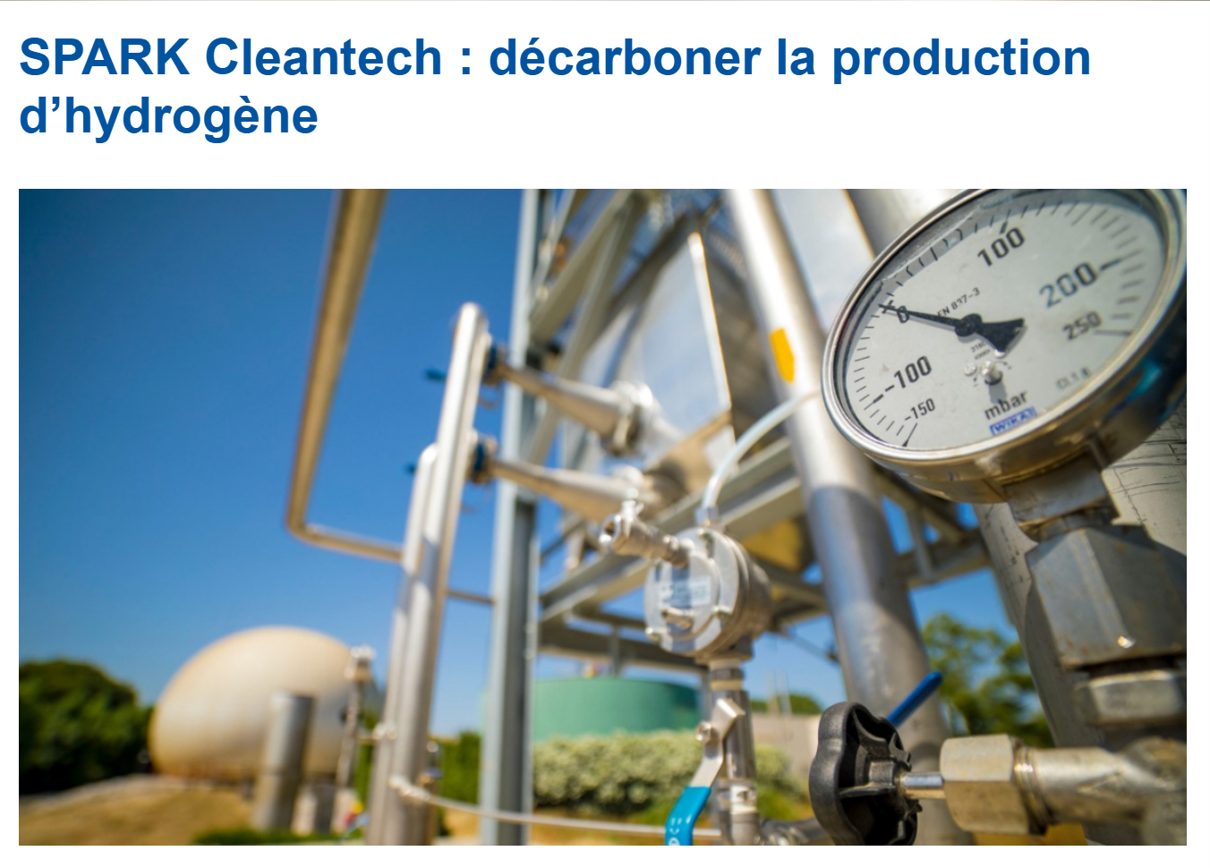
This is where I came across SPARK Cleantech.
What immediately fascinated me was not simply the technology.
It was the ambition.
Some startups improve existing processes.
Others rethink them from first principles.
SPARK belongs to the second category.
Its objective is to produce low-carbon hydrogen through an innovative cold plasma process that separates methane into two valuable products:
- hydrogen,
- and solid carbon.
Instead of releasing carbon into the atmosphere, the process keeps it in solid form while aiming for a significantly lower electricity demand than conventional electrolysis. It also opens the door to progressively integrating renewable biomethane as feedstock.
Whether this technology ultimately becomes one of tomorrow’s industrial standards remains to be seen.
That is the nature of DeepTech.
Long development cycles.
Scientific uncertainty.
Industrial validation.
Scale-up.
Execution matters as much as invention.
But this is precisely what makes DeepTech so exciting.
It reminds us that the energy transition will not rely on one single technology.
It will require multiple complementary solutions, each addressing different constraints around energy, infrastructure, cost and resources.
This investment also reinforced another conviction.
Europe—and France in particular—still possesses extraordinary scientific talent.
The challenge is no longer generating ideas.
It is transforming research into industrial businesses capable of changing markets.
That journey is undoubtedly more demanding than building software.
But when it succeeds, the impact can be measured over decades.
And perhaps that is one of the most inspiring lessons I have learned over the past months.
Innovation is not only about moving faster.
Sometimes, it is about thinking differently enough to change the rules of the game.
News
-
When AI leaves the screen — Part II
A few days ago, I wrote that AI becomes really interesting when it leaves the screen. Since then, the news has almost been making the case for me. In France,…
-
AI becomes really interesting when it leaves the screen.
In my previous post, I asked: What if European Tech is not dying — but maturing? Perhaps one of the best places to look for an answer is Artificial Intelligence.…
-
What if European Tech is not dying — but maturing?
Back from the summer break, with lots of things happening in the French startups landcape like Pasqal IPOs at the Nasdaq and raising $280m, or Mistral signing a large contract…