When AI leaves the screen — Part II
A few days ago, I wrote that AI becomes really interesting when it leaves the screen.
Since then, the news has almost been making the case for me.
In France, Mistral has raised €3 billion to accelerate not only AI models, but infrastructure and deployment into real organisations.
In Europe, new investment is flowing into Physical AI — robotics, manufacturing, logistics, energy and infrastructure.
And then I discovered an example that pushes the idea even further.
AI is now leaving the Earth.
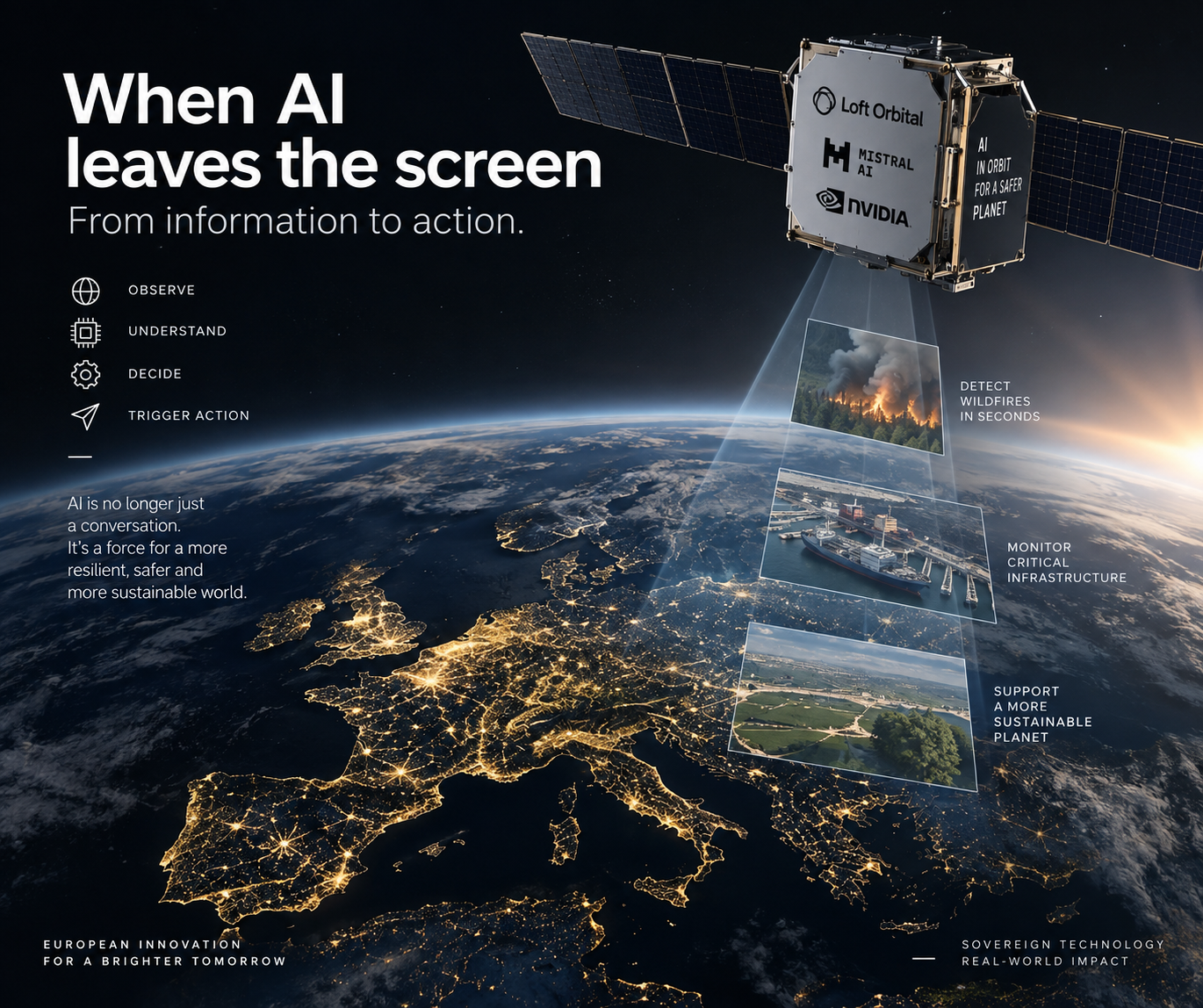
Franco-American startup Loft Orbital is developing a constellation of 50 AI-equipped satellites, backed by a $1 billion commitment from the UAE.
The interesting part is not simply the satellites.
Traditionally, they collect images and data, send them back to Earth, and someone analyses them.
Now imagine the intelligence travelling with the satellite.
A camera detects the beginning of a forest fire.
AI analyses it onboard.
An alert can be sent within seconds.
The same principle could apply to ports, energy infrastructure, transport networks or other critical assets.
This is where AI becomes fascinating to me.
Not because it can generate another impressive answer.
But because it can observe, understand, decide and trigger action in the physical world.
And the examples are multiplying.
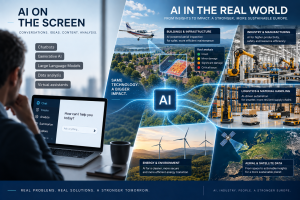
Aerial imagery analysing roofs for thousands of craftsmen.
Robots learning to operate inside factories.
AI optimizing warehouses and energy systems.
Satellites interpreting what they see before the data even reaches Earth.
Different technologies.
Different industries.
But the same transition:
AI → from information to action.
Perhaps this is also where Europe has a particularly interesting card to play.
We have spent years discussing our lack of hyperscalers compared with the US.
But Europe has something else.
Factories.
Machines.
Energy infrastructure.
Aerospace.
Logistics networks.
Industrial know-how.
And millions of real-world problems waiting for better solutions.
Add AI to that industrial base and something interesting happens.
Our so-called “old economy” may actually become one of our greatest technological assets.
The next chapter of AI may therefore not be about who builds the chatbot we use.
It may be about who puts intelligence into the physical world around us.
And Europe may be better positioned for that chapter than we think.
News
-
AI becomes really interesting when it leaves the screen.
In my previous post, I asked: What if European Tech is not dying — but maturing? Perhaps one of the best places to look for an answer is Artificial Intelligence.…
-
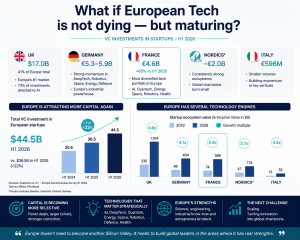
What if European Tech is not dying — but maturing?
Back from the summer break, with lots of things happening in the French startups landcape like Pasqal IPOs at the Nasdaq and raising $280m, or Mistral signing a large contract…
-
My fourth Venture Capital experience took me somewhere I never expected.
After healthcare. After artificial intelligence. After deeptech and energy. I found myself discovering… stablecoins. To be honest, I initially thought this world was mainly about crypto. I quickly realized it…