From owning what sits behind AI… to European sovereignty.
In my last post, I argued that Europe’s AI opportunity may not only be about owning the screen — but owning enough of what sits behind it.
Chips. Compute. Energy. Industrial software. Infrastructure.
But why does this matter?
Perhaps because it leads to a much bigger question:
What does European sovereignty actually mean?
For me, it cannot mean producing everything ourselves.
And it certainly shouldn’t mean preventing international investors from financing European companies.
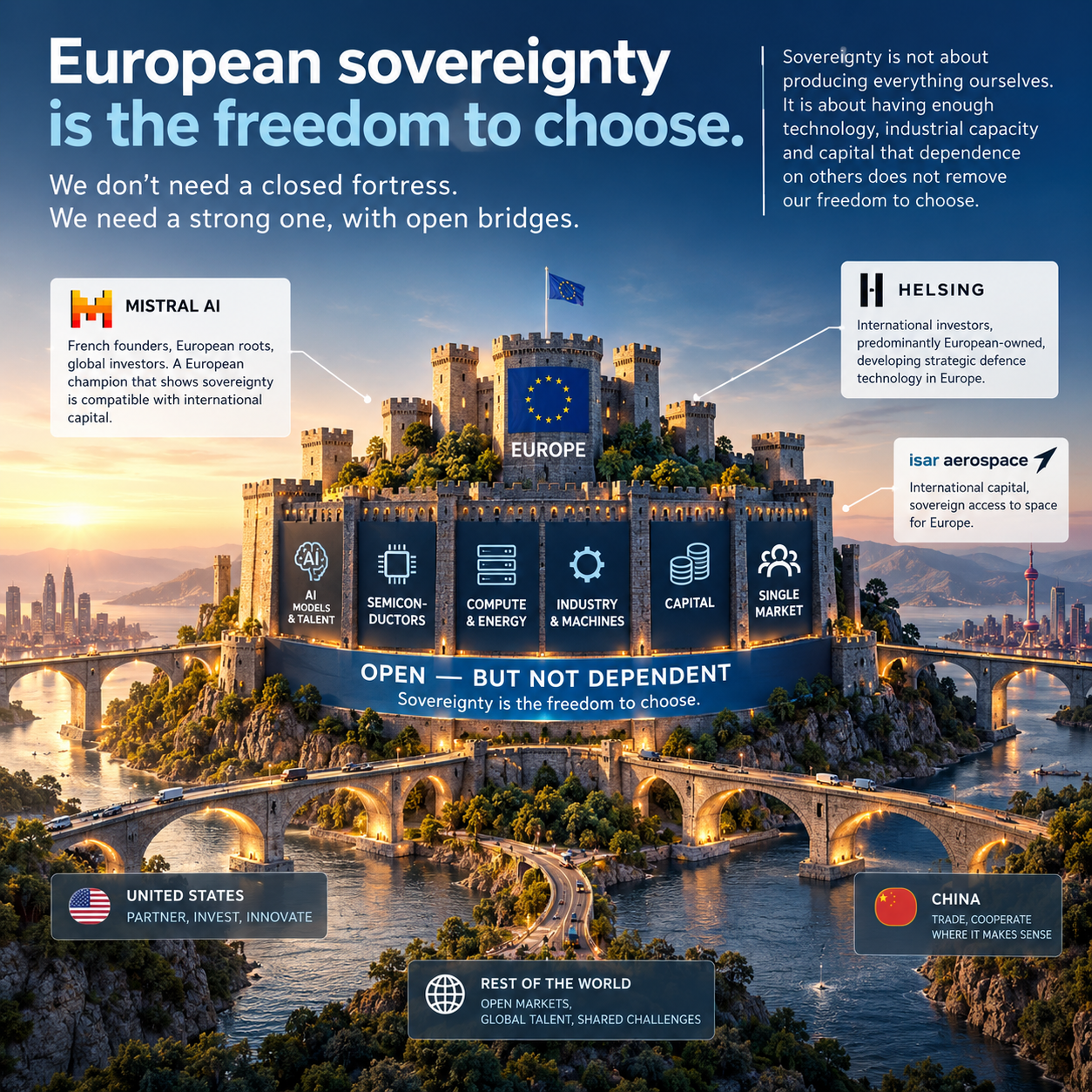
Take Mistral AI.
French founders. European roots. A clear ambition around sovereign AI.
Yet its latest €3 billion financing brings together investors from Europe, Asia and North America.
Does international capital make Mistral less European?
I don’t think that is the right question.
Germany offers similar examples.
Helsing has raised $1.8 billion from international investors while remaining predominantly European-owned and developing strategic technology in Europe.
Isar Aerospace attracts international capital while building something Europe clearly needs: sovereign access to space.
Perhaps sovereignty therefore needs a simpler definition:
Sovereignty is not autarky.
It is having enough technology, industrial capacity and capital that dependence on others does not remove your freedom to choose.
This is also where my own professional experience between France and Germany makes me optimistic.
We often approached problems differently — sometimes very differently!
But our strengths were usually more complementary than competitive.
France does not need to reproduce Germany.
Germany does not need to reproduce the Netherlands.
And Europe does not need to reproduce Silicon Valley.
France brings AI and engineering talent.
Germany brings industry and machines.
The Netherlands brings semiconductors.
The Nordics increasingly bring energy and compute.
Connect these strengths with European long-term capital and one large market, while remaining open to international investors and partners, and sovereignty starts to look less like protectionism and more like strategy.
Open — but not dependent.
Europe doesn’t need to own everything.
But we need to own enough of the critical layers that others also need us.
That creates interdependence rather than dependence.
And ultimately, perhaps sovereignty is simply this:
the freedom to choose who you work with — rather than having no choice at all.
News
-
One more reason to believe in Europe!
After the recent concerns expressed by students in France, and before turning our attention, once again, to what is happening across the Atlantic, here is some encouraging news from Europe.…
-
Are we so busy managing today’s crises that we are forgetting to build tomorrow?
Recent student protests in France, echoed in other European countries, have left me with an uncomfortable question. Overcrowded classrooms. Crumbling school buildings. Missing teachers. Young people increasingly worried about their…
-
Perhaps Europe is already in the AI race. We are just looking in the wrong places.
Jensen Huang, NVIDIA’s CEO, recently challenged Europe to enter the AI race before worrying about staying in it. Fair point. But look at this week’s announcements. 🇫🇷 NVIDIA is investing…