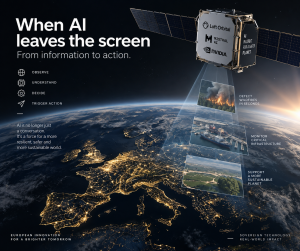
AI becomes really interesting when it leaves the screen.
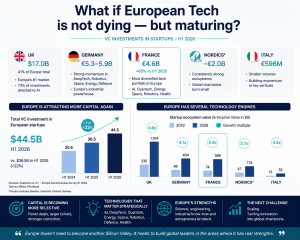
In my previous post, I asked:
What if European Tech is not dying — but maturing?
Perhaps one of the best places to look for an answer is Artificial Intelligence.
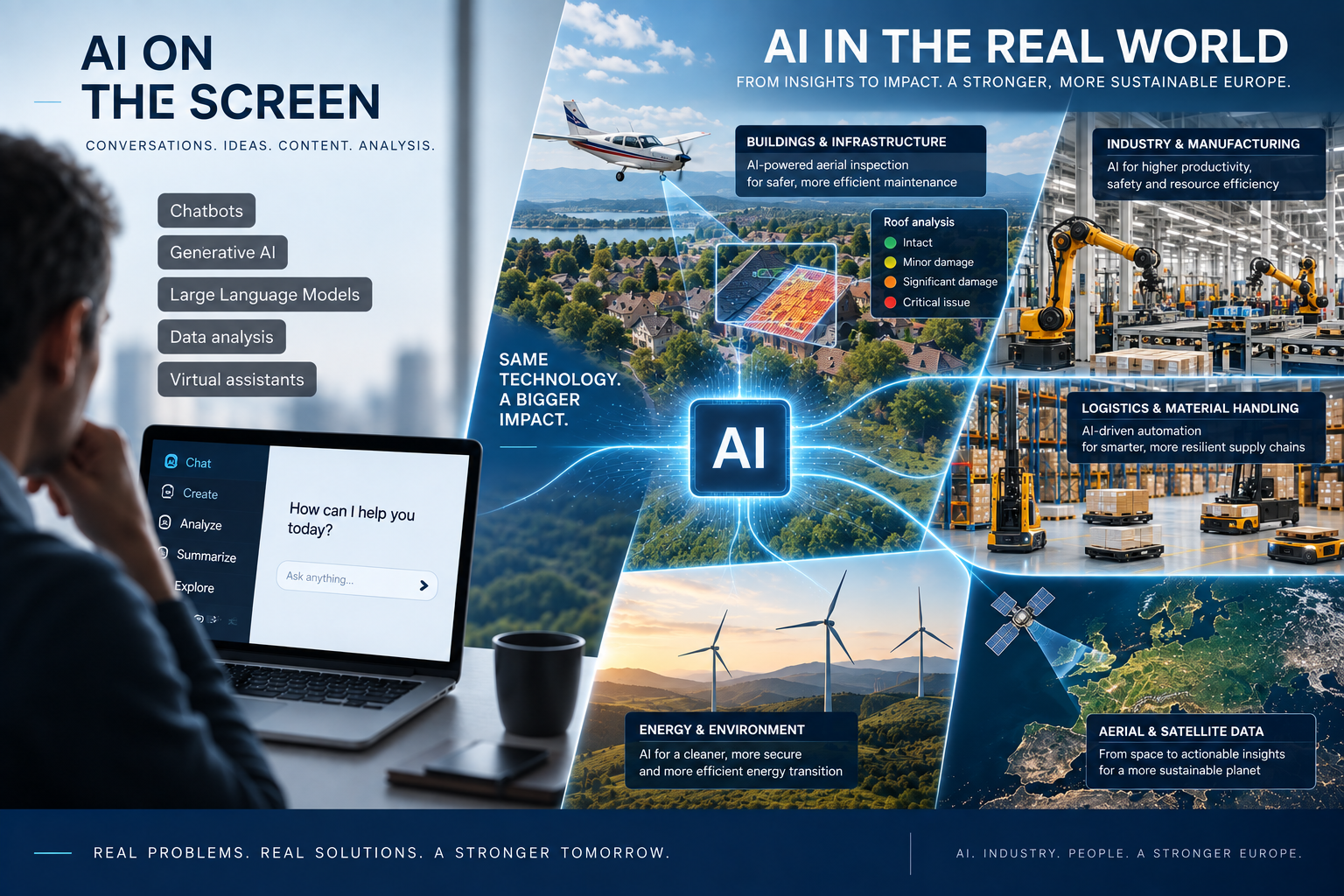
Most of the AI conversation today is dominated by what happens on our screens.
Chatbots.
Generative AI.
Large Language Models.
Fascinating, certainly.
But from my industrial perspective, I am increasingly interested in what happens when AI leaves the screen and enters the physical world.
Factories.
Warehouses.
Energy systems.
Infrastructure.
Buildings.
This is where Europe’s traditional industrial strengths could become an advantage rather than a weakness.
A very concrete example came through my recent Business Angel experience with BIRDIA.
The technology is sophisticated: high-resolution aerial imagery combined with hybrid AI to detect, identify and qualify physical objects.
But the initial use case is wonderfully pragmatic.
Look at a roof.
Is it damaged?
Where?
How seriously?
What intervention is required?
For thousands of roofing companies, insurers and eventually many other users, AI can transform a manual, time-consuming and sometimes dangerous inspection into actionable information.
This is what I like about Physical AI.
Not AI looking for a problem.
A real problem finding a better solution through AI.
And something else interesting is happening.
Europe’s established industrial companies are beginning to participate directly in this ecosystem.
A company I know particularly well from my former professional world, Jungheinrich, has just backed a new €100 million VC fund dedicated to DeepTech, focusing particularly on Physical AI, energy, enterprise AI and logistics.
Think about what an industrial company can bring to a startup beyond money:
Real use cases.
Industrial expertise.
Customers.
Testing environments.
Routes to market.
And perhaps most importantly: an understanding of what actually works outside the laboratory.
This could become one of Europe’s underestimated advantages.
We may not have the hyperscalers of the US.
We may not have China’s enormous domestic technology ecosystem.
But Europe has something else:
a huge industrial installed base combined with world-class engineering, increasingly connected to entrepreneurs, AI and venture capital.
Perhaps we have therefore been measuring Europe against the wrong definition of Tech.
The next European technology champions may not only live in the cloud.
They may be inspecting our roofs, optimizing our factories, managing our energy, moving goods through warehouses or operating machines.
AI becomes really interesting when it leaves the screen.
And Europe may have more cards to play there than we sometimes think.
News
-
When AI leaves the screen — Part II
A few days ago, I wrote that AI becomes really interesting when it leaves the screen. Since then, the news has almost been making the case for me. In France,…
-
What if European Tech is not dying — but maturing?
Back from the summer break, with lots of things happening in the French startups landcape like Pasqal IPOs at the Nasdaq and raising $280m, or Mistral signing a large contract…
-
My fourth Venture Capital experience took me somewhere I never expected.
After healthcare. After artificial intelligence. After deeptech and energy. I found myself discovering… stablecoins. To be honest, I initially thought this world was mainly about crypto. I quickly realized it…