What if European Tech is not dying — but maturing?
Back from the summer break, with lots of things happening in the French startups landcape like Pasqal IPOs at the Nasdaq and raising $280m, or Mistral signing a large contract with Saudi Arabia, I wanted to start with some numbers and put things in perspective.
We hear a lot about Europe’s inability to compete with the US and China in technology.
And, of course, the gap is real.
But looking at the first half of 2026, I see some reasons for optimism.
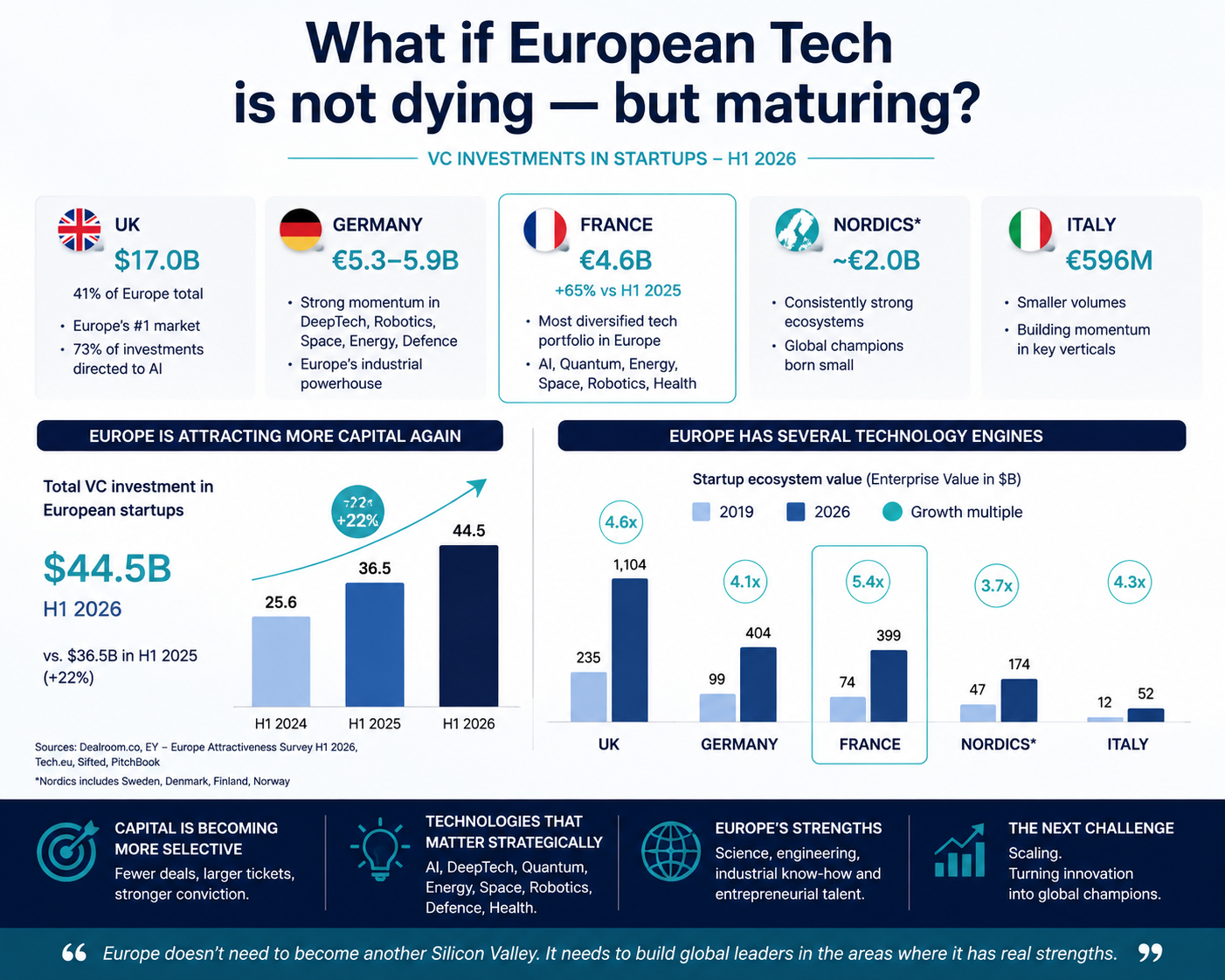
French startups raised €4.6 billion — up 65% year-on-year.
Germany raised slightly more, with strong investments in robotics, defence, space and energy.
The UK remains Europe’s undisputed leader, attracting around $17 billion — although AI alone represented almost three quarters of that amount.
Italy remains smaller, while the Nordic countries continue to produce remarkable technology companies relative to the size of their economies.
But perhaps we are looking at the wrong competition.
France vs Germany vs UK is interesting.
Europe vs the rest of the world is much more important.
And from that perspective, something interesting is happening.
European startups attracted around $44.5 billion in the first half of 2026.
Capital is returning.
But differently.
Fewer deals.
Larger tickets.
More selectivity.
And increasingly, capital is flowing towards technologies that matter strategically:
AI.
DeepTech.
Quantum.
Energy.
Space.
Robotics.
Defence.
Health.
France is particularly interesting.
Not because it leads Europe in funding — it doesn’t.
But because its technology ecosystem has become remarkably diversified.
Over the past months, my first experiences as a Business Angel have given me a very small window into this world.
Healthcare. AI. Plasma technology. Fintech.
Four completely different businesses.
But the same thing struck me every time:
ambitious founders trying to solve real problems.
Europe certainly still has weaknesses.
Scaling remains difficult. Capital markets remain fragmented. And too many successful European companies eventually look across the Atlantic for the funding required to become global champions.
But perhaps the conclusion shouldn’t be that European Tech is dead.
Perhaps it is that European Tech is growing up.
More selective.
More industrial.
More strategic.
And increasingly connected to Europe’s need for technological sovereignty.
We will not beat Silicon Valley by trying to recreate Silicon Valley.
Nor China by trying to become China.
Europe needs to turn its own strengths — science, engineering, industrial know-how and entrepreneurial talent — into scalable global businesses.
The ingredients are there.
The next challenge is scale.
And that is a challenge worth being optimistic about.
News
-
When AI leaves the screen — Part II
A few days ago, I wrote that AI becomes really interesting when it leaves the screen. Since then, the news has almost been making the case for me. In France,…
-
AI becomes really interesting when it leaves the screen.
In my previous post, I asked: What if European Tech is not dying — but maturing? Perhaps one of the best places to look for an answer is Artificial Intelligence.…
-
My fourth Venture Capital experience took me somewhere I never expected.
After healthcare. After artificial intelligence. After deeptech and energy. I found myself discovering… stablecoins. To be honest, I initially thought this world was mainly about crypto. I quickly realized it…