Material Handling: an early laboratory of electrification
Last week, I started a short series of posts about the electrification of industry.
The discussion is often framed at a national level — energy sovereignty, infrastructure, or public policy.
But interestingly, one industrial sector crossed that bridge long before electrification became a political priority.
Material handling.
Walk into a modern warehouse in Europe today and you will notice something striking:
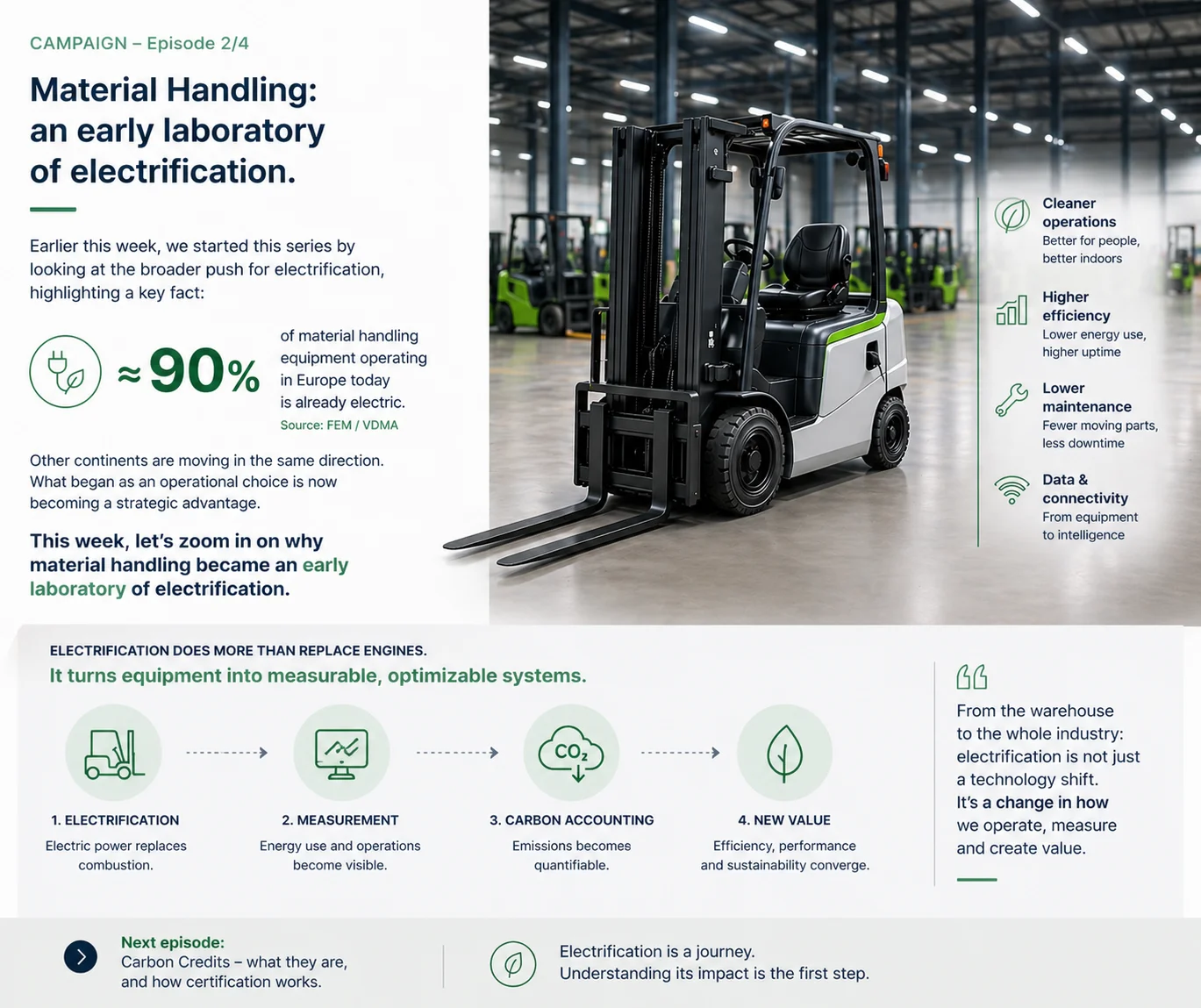
close to 90% of material handling equipment already runs on electricity.
Forklifts, pallet trucks, warehouse vehicles.
Not because of environmental regulation.
Not because of government plans.
Simply because electric systems proved more efficient, more reliable, and easier to operate indoors.
What started as a practical operational decision gradually created something more important.
Electrification transformed machines into measurable systems.
Energy consumption can be monitored.
Fleet utilization can be optimized.
Maintenance can be predicted.
In other words, electrification quietly turned industrial equipment into data-producing assets.
And once systems become measurable, something new becomes possible:
their carbon footprint can also be measured.
Which brings us to the next topic in this series.
Because once emissions can be quantified, they can also be accounted for, certified, and sometimes traded.
Next episode: Carbon credits — what they actually represent, and how certification works.
News
-
When AI leaves the screen — Part II
A few days ago, I wrote that AI becomes really interesting when it leaves the screen. Since then, the news has almost been making the case for me. In France,…
-
AI becomes really interesting when it leaves the screen.
In my previous post, I asked: What if European Tech is not dying — but maturing? Perhaps one of the best places to look for an answer is Artificial Intelligence.…
-
What if European Tech is not dying — but maturing?
Back from the summer break, with lots of things happening in the French startups landcape like Pasqal IPOs at the Nasdaq and raising $280m, or Mistral signing a large contract…