What if Europe’s AI opportunity is not only about owning the screen — but owning what sits behind it?
In my last post, I wrote about AI leaving the screen and entering the physical world.
Factories.
Warehouses.
Buildings.
Energy systems.
Satellites.
But that raises another question.
What sits behind all this intelligence?
Chips.
Computing power.
Data centres.
Energy.
Cloud infrastructure.
Industrial software.
And increasingly, the ability to connect all these layers.
This week, Dutch startup Axelera AI launched its new Europa AI chip, designed to run increasingly powerful AI applications on infrastructure that companies can control themselves.
Perhaps not as spectacular as the latest chatbot.
But possibly just as strategic.
Because we often talk about European AI sovereignty as if it were mainly about building European AI models.
It isn’t.
If the model is European but the chips, computing infrastructure, cloud and energy systems underneath it are entirely dependent on others, how sovereign are we really?
This is where I see an interesting European opportunity.
And perhaps my own professional experience makes me slightly biased here.
I spent a large part of my career working between France and Germany, within a European industrial group.
Different cultures.
Different ways of approaching problems.
Sometimes different ways of approaching meetings too!
But I also saw something much more important:
when European industrial strengths are combined, 1 + 1 can genuinely become more than 2.
Today, we are beginning to see the same logic emerging around AI.
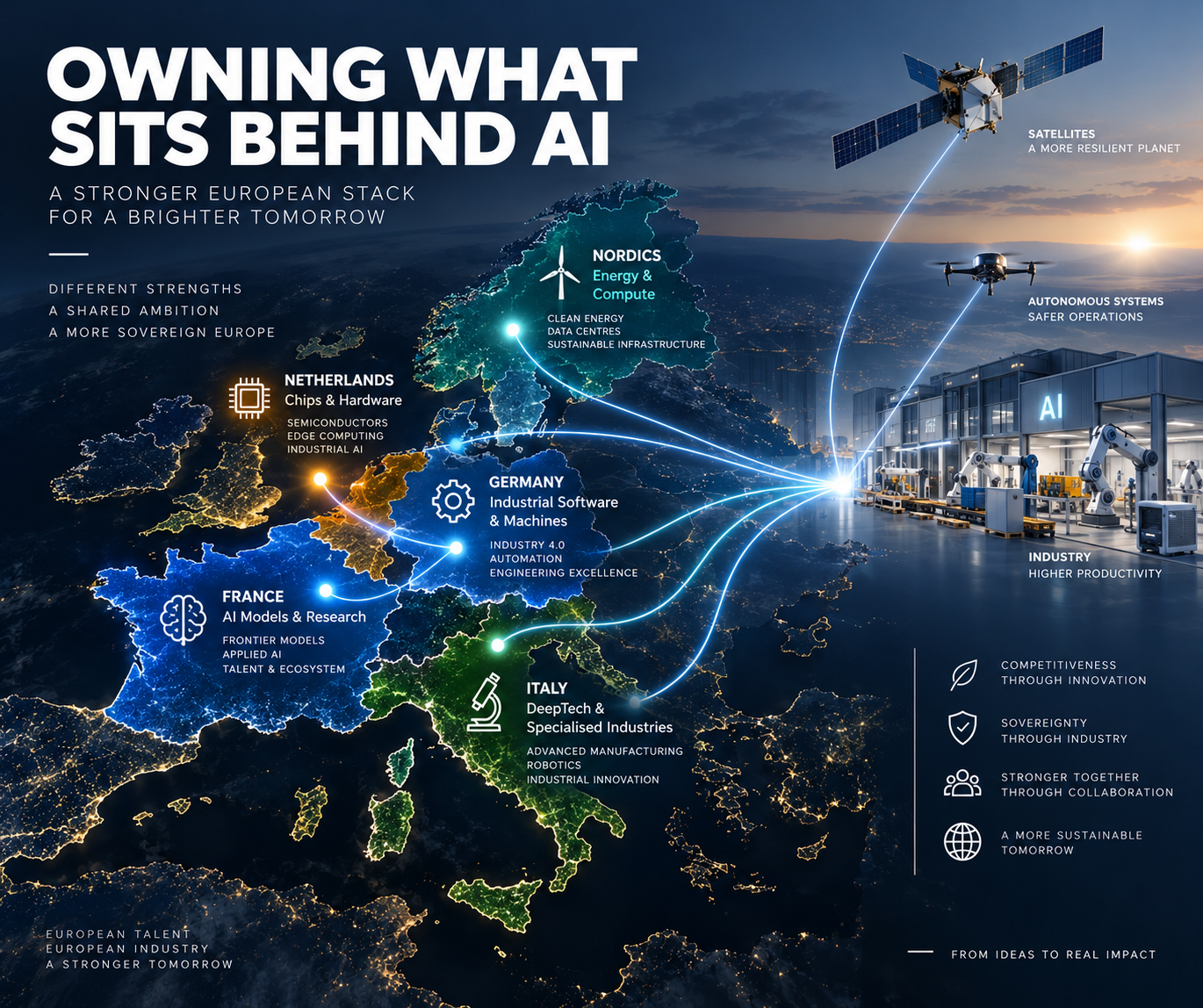
France brings a remarkable ecosystem in mathematics, AI research and new companies such as Mistral.
Germany brings an extraordinary industrial base, enterprise software and engineering capabilities.
SAP and Mistral are already working together to combine European AI models with European enterprise technology.
France and Germany are also pushing joint initiatives in industrial AI, semiconductors and computing infrastructure.
Add the Netherlands and its semiconductor ecosystem.
The Nordics and their energy and data-centre capabilities.
Italy and its growing DeepTech base.
Suddenly, the European map starts to look rather different.
Perhaps our weakness is that we too often look at these ecosystems country by country.
France versus Germany.
Germany versus the UK.
Italy versus France.
But NVIDIA doesn’t think state by state.
And Silicon Valley doesn’t think city by city.
Europe’s opportunity may therefore depend less on creating 27 national technology ecosystems — and more on learning to connect them.
Models + chips + software + energy + industry + capital.
That is the stack.
And as AI increasingly moves from generating information to acting in the real world, owning more of that stack becomes strategically important.
Europe may never own the screen.
But perhaps it doesn’t need to.
It needs to own enough of what sits behind it.
And maybe the European industrial cooperation I experienced throughout my career is not part of the old economy after all.
It could be part of the next one.
News
-
One more reason to believe in Europe!
After the recent concerns expressed by students in France, and before turning our attention, once again, to what is happening across the Atlantic, here is some encouraging news from Europe.…
-
Are we so busy managing today’s crises that we are forgetting to build tomorrow?
Recent student protests in France, echoed in other European countries, have left me with an uncomfortable question. Overcrowded classrooms. Crumbling school buildings. Missing teachers. Young people increasingly worried about their…
-
Perhaps Europe is already in the AI race. We are just looking in the wrong places.
Jensen Huang, NVIDIA’s CEO, recently challenged Europe to enter the AI race before worrying about staying in it. Fair point. But look at this week’s announcements. 🇫🇷 NVIDIA is investing…