
News
-
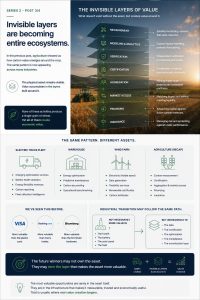
The invisible layers often become more valuable than the asset itself.
A farmer still grows wheat. Yet around that wheat, entirely new sources of value are emerging:carbon measurement, certification, financing, insurance, market access and monetization. None of these activities produce a single grain. Yet all of them create economic value. The same phenomenon is appearing across industries. An electric fleet generates charging optimization, battery analytics and…
-
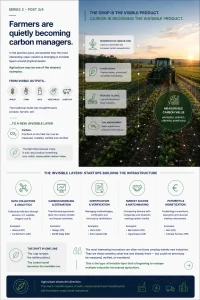
Farmers are quietly becoming carbon managers
In the previous post, I suggested that some of the most interesting value creation opportunities are emerging in layers that remain largely invisible. Not in the physical asset itself. But around it. Agriculture may be one of the clearest examples. Traditionally, a farm produced visible outputs: The economic model was relatively straightforward. Produce. Harvest. Sell.…
-
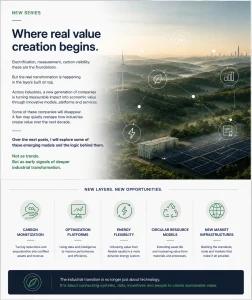
Where does real value creation actually begin?
Thank you all for your interest and valuable comments. After the last few posts on electrification, carbon accounting, and emerging industrial business models, one question naturally follows:Where does real value creation actually begin?Not in theory.Not in PowerPoint presentations.But in concrete operational models capable of turning:electrification, measurable emissions, and carbon visibility into viable economic systems.What is…
-
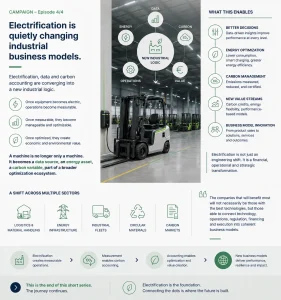
Electrification is quietly changing industrial business models
Over the past few posts, I wrote about electrification, material handling, and carbon accounting. At first glance, these topics may seem separate. They are not. They are gradually converging into a new industrial logic. For decades, industrial performance was mainly measured through: Electrification changes this. Once equipment becomes electric, operations become measurable in far greater…
-
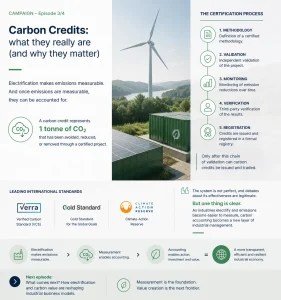
Carbon Credits: what they really are (and why they matter)
Over the past two posts, I wrote about the electrification of industry, and how sectors like material handling quietly became early laboratories of that transition. Electrification brings many advantages.But it also produces something new. Measurable emissions. Once energy consumption becomes measurable, carbon emissions can be quantified.And once emissions are quantified, they can enter a broader system…
-
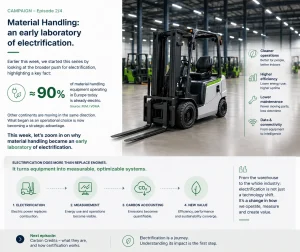
Material Handling: an early laboratory of electrification
Last week, I started a short series of posts about the electrification of industry. The discussion is often framed at a national level — energy sovereignty, infrastructure, or public policy. But interestingly, one industrial sector crossed that bridge long before electrification became a political priority. Material handling. Walk into a modern warehouse in Europe today and you will notice…
-
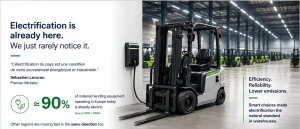
Electrification is already here. We just rarely notice it.
In recent weeks, the French press has echoed the government’s renewed push toward electrification. As Sébastien Lecornu recently stated when presenting elements of the national strategy: “L’électrification du pays est une condition de notre souveraineté énergétique et industrielle.” National plans and public debates often make electrification sound like a future objective. In reality, parts of…
-
Rare Earth Recycling: Europe’s Fast Track to Supply Chain Resilience
A few weeks ago, I wrote about the pause that follows the end of a long chapter, and how that silence helps clarify where one can be genuinely useful next. This week feels like the beginning of that next chapter. One topic that kept resurfacing during this pause is rare earth elements. Not the chemistry.…
-
The Day After: What a Pause Reveals About Leadership and Change
Last month, I handed in my badge and my car keys.The surprising part is not the end itself.It’s what becomes visible the day after.When the calendar empties, a few things appear very clearly.First: most decisions are made under un-needed urgency.Remove the noise, and you realize how often speed replaced judgment.Second: many “business problems” are in…

- « Précédent
- 1
- 2