The Day After: What a Pause Reveals About Leadership and Change

Last month, I handed in my badge and my car keys.
The surprising part is not the end itself.
It’s what becomes visible the day after.
When the calendar empties, a few things appear very clearly.
First: most decisions are made under un-needed urgency.
Remove the noise, and you realize how often speed replaced judgment.
Second: many “business problems” are in fact framing problems. This is what I learned during one famous sessions at INSEAD.
We optimize within models we no longer question.
Third: technology is rarely the hard part.
Whether it’s AI-based systems, leads on alternative materials, or carbon mechanisms, the real difficulty sits elsewhere — governance, incentives, accountability.
This pause is useful precisely because it exposes these patterns.
It’s also clarifying where I can be genuinely useful next:
helping leaders or boards think through complex transitions — not by selling solutions, but by stress-testing assumptions behind new business models, emerging technologies, and sustainability narratives.
Innovation doesn’t fail because ideas are weak.
It fails because uncomfortable questions are postponed.
Some roles begin with momentum.
Others begin by slowing things down enough to see what actually needs to change!
More in the weeks to come!
News
-
When AI leaves the screen — Part II
A few days ago, I wrote that AI becomes really interesting when it leaves the screen. Since then, the news has almost been making the case for me. In France,…
-
AI becomes really interesting when it leaves the screen.
In my previous post, I asked: What if European Tech is not dying — but maturing? Perhaps one of the best places to look for an answer is Artificial Intelligence.…
-
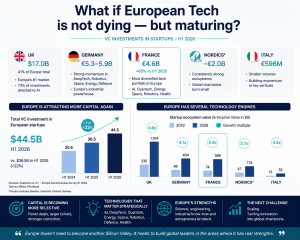
What if European Tech is not dying — but maturing?
Back from the summer break, with lots of things happening in the French startups landcape like Pasqal IPOs at the Nasdaq and raising $280m, or Mistral signing a large contract…