Electrification is quietly changing industrial business models
Over the past few posts, I wrote about electrification, material handling, and carbon accounting.
At first glance, these topics may seem separate.
They are not.
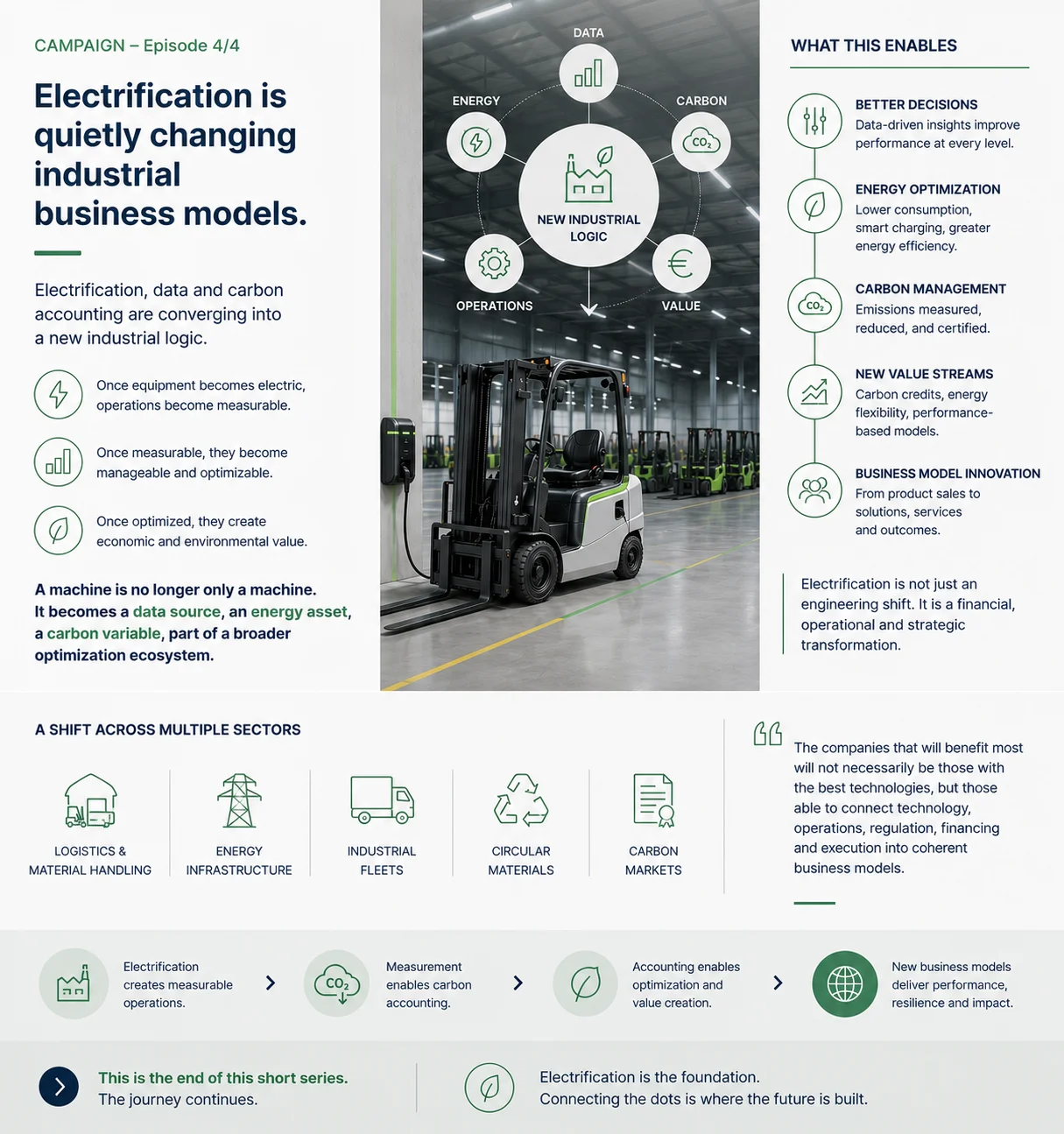
They are gradually converging into a new industrial logic.
For decades, industrial performance was mainly measured through:
- productivity
- cost
- uptime
- scale
Electrification changes this.
Once equipment becomes electric, operations become measurable in far greater detail.
Energy consumption.
Fleet utilization.
Charging patterns.
Carbon emissions.
And once these parameters become measurable, they also become manageable, optimizable… and eventually monetizable.
This is where industrial business models start evolving.
A machine is no longer only a machine.
It becomes:
- a data source
- an energy asset
- a carbon variable
- part of a broader optimization ecosystem
The same shift is now emerging across multiple sectors.
Energy infrastructure.
Logistics.
Industrial fleets.
Circular materials.
Carbon markets.
This does not mean every new concept will succeed.
Far from it.
But it does suggest that electrification is not simply an engineering transition anymore.
It is becoming a financial, operational, and strategic transformation.
And perhaps this is the most important point.
The companies that will benefit most from this transition may not necessarily be those with the best technologies.
But those capable of connecting:
technology, operations, regulation, financing, and industrial execution into coherent business models.
That is usually where real value creation begins.
News
-
When AI leaves the screen — Part II
A few days ago, I wrote that AI becomes really interesting when it leaves the screen. Since then, the news has almost been making the case for me. In France,…
-
AI becomes really interesting when it leaves the screen.
In my previous post, I asked: What if European Tech is not dying — but maturing? Perhaps one of the best places to look for an answer is Artificial Intelligence.…
-
What if European Tech is not dying — but maturing?
Back from the summer break, with lots of things happening in the French startups landcape like Pasqal IPOs at the Nasdaq and raising $280m, or Mistral signing a large contract…