The invisible layers often become more valuable than the asset itself.
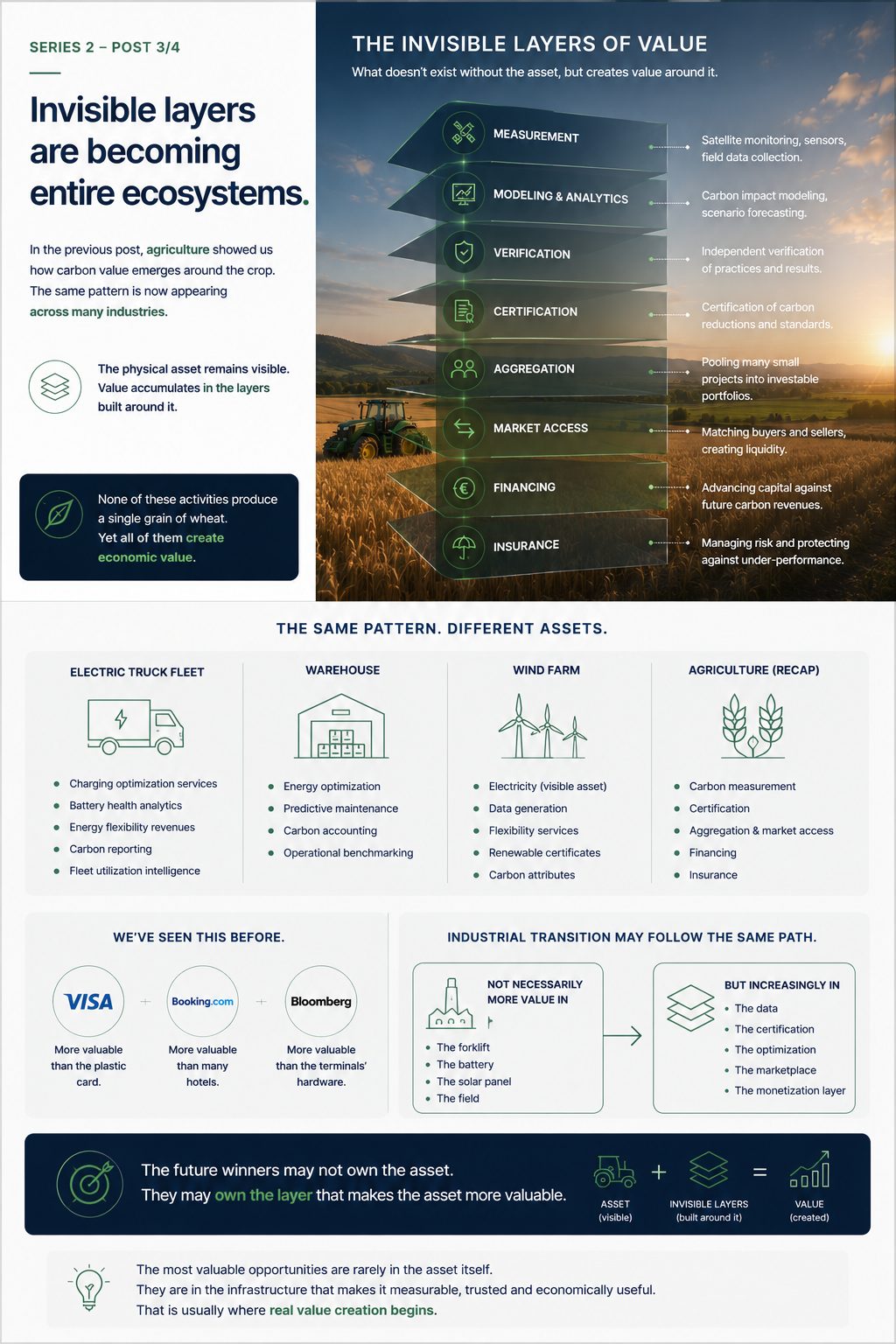
A farmer still grows wheat.
Yet around that wheat, entirely new sources of value are emerging:
carbon measurement, certification, financing, insurance, market access and monetization.
None of these activities produce a single grain.
Yet all of them create economic value.
The same phenomenon is appearing across industries.
An electric fleet generates charging optimization, battery analytics and energy flexibility.
A warehouse generates predictive maintenance, operational benchmarking and carbon accounting.
A wind farm generates not only electricity, but also data, certificates and carbon attributes.
The physical asset remains visible.
But value increasingly accumulates in the layers built around it.
We have seen this before.
Visa became more valuable than the plastic card.
Booking became more valuable than many hotels.
Bloomberg became more valuable than the hardware running its terminals.
Industrial transition may follow the same path.
The future winners may not own the forklift, the battery, the solar panel or the field.
They may own the data, the certification, the optimization, the marketplace or the monetization layer that makes those assets more valuable.
And that is usually where real value creation begins.
News
-
When AI leaves the screen — Part II
A few days ago, I wrote that AI becomes really interesting when it leaves the screen. Since then, the news has almost been making the case for me. In France,…
-
AI becomes really interesting when it leaves the screen.
In my previous post, I asked: What if European Tech is not dying — but maturing? Perhaps one of the best places to look for an answer is Artificial Intelligence.…
-
What if European Tech is not dying — but maturing?
Back from the summer break, with lots of things happening in the French startups landcape like Pasqal IPOs at the Nasdaq and raising $280m, or Mistral signing a large contract…