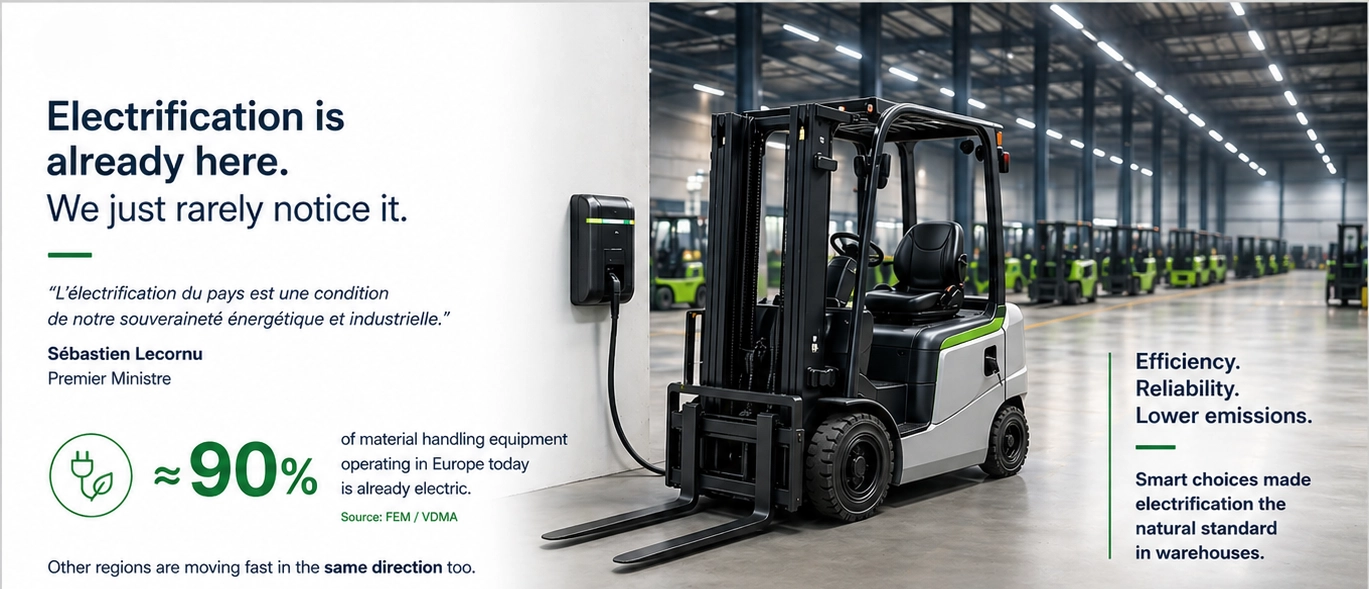
Electrification is already here. We just rarely notice it.
In recent weeks, the French press has echoed the government’s renewed push toward electrification.
As Sébastien Lecornu recently stated when presenting elements of the national strategy:
“L’électrification du pays est une condition de notre souveraineté énergétique et industrielle.”
National plans and public debates often make electrification sound like a future objective.
In reality, parts of industry have already been living this transition for years.
One example is rarely mentioned: material handling.
Walk into a modern warehouse in Europe today and you will notice something interesting.
Most machines you see are already electric.
Forklifts, pallet trucks, warehouse vehicles.
Depending on the segment, close to 90 % of material handling equipment operating in Europe today runs on electricity.
Not because of regulation.
Not because of sustainability targets.
Simply because electric solutions proved more efficient, more reliable, and easier to operate indoors.
Other regions are now moving rapidly in the same direction.
In many ways, logistics and warehouse operations became a quiet laboratory of industrial electrification, long before electrification became a national policy debate.
Which raises an interesting thought.
If one sector has already crossed that threshold, what happens when the rest of industry begins to follow?
Because electrification does more than replace engines.
It changes how industrial systems are measured, optimized… and eventually how their carbon footprint is accounted for.
News
-
When AI leaves the screen — Part II
A few days ago, I wrote that AI becomes really interesting when it leaves the screen. Since then, the news has almost been making the case for me. In France,…
-
AI becomes really interesting when it leaves the screen.
In my previous post, I asked: What if European Tech is not dying — but maturing? Perhaps one of the best places to look for an answer is Artificial Intelligence.…
-
What if European Tech is not dying — but maturing?
Back from the summer break, with lots of things happening in the French startups landcape like Pasqal IPOs at the Nasdaq and raising $280m, or Mistral signing a large contract…