Carbon Credits: what they really are (and why they matter)
Over the past two posts, I wrote about the electrification of industry, and how sectors like material handling quietly became early laboratories of that transition.
Electrification brings many advantages.
But it also produces something new.
Measurable emissions.
Once energy consumption becomes measurable, carbon emissions can be quantified.
And once emissions are quantified, they can enter a broader system of accounting.
This is where carbon credits come in.
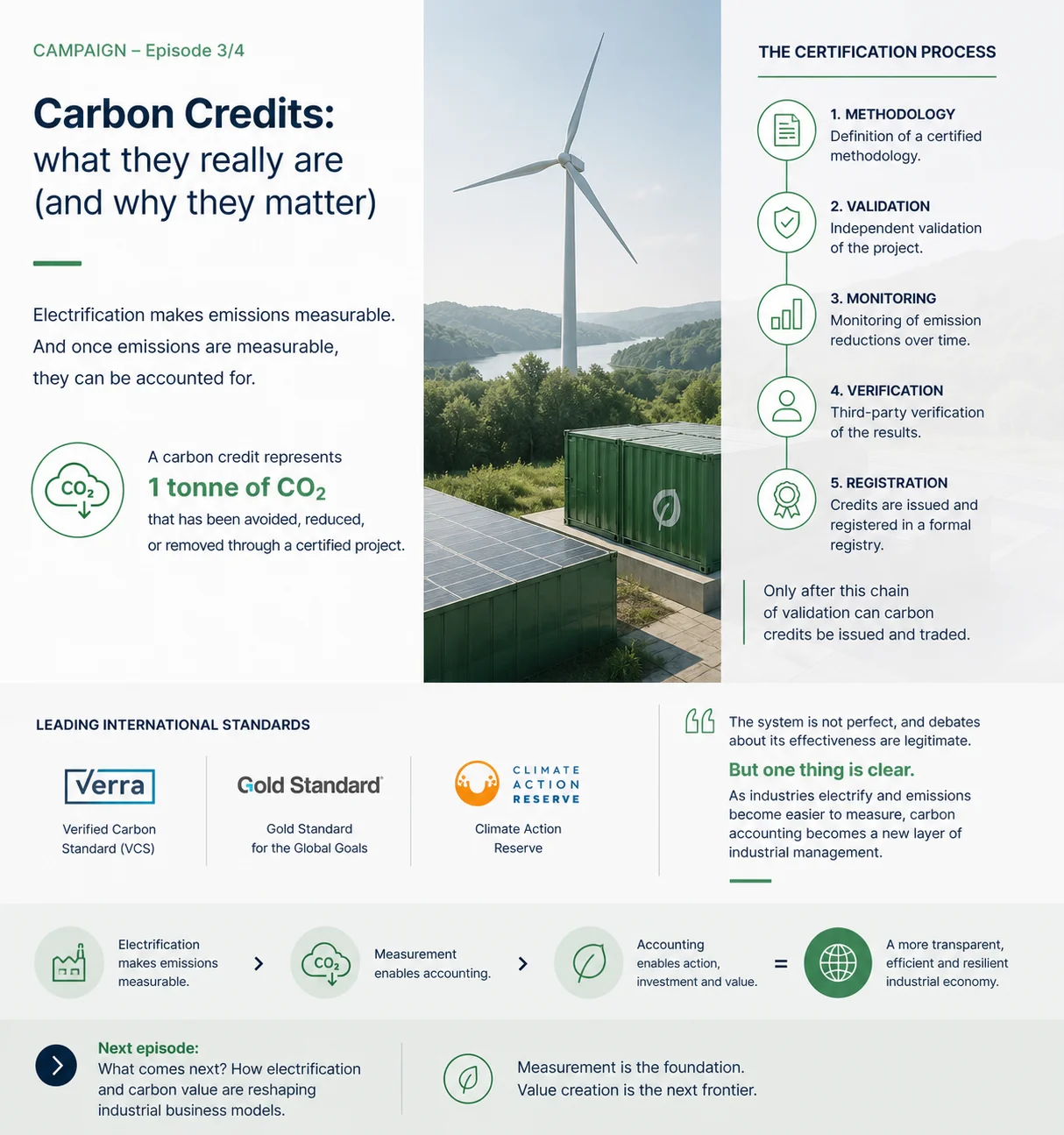
In simple terms, a carbon credit represents one tonne of CO₂ that has been avoided, reduced, or removed through a certified project.
But issuing such credits is not simply a declaration.
Projects must follow a rigorous process typically involving:
• Definition of a certified methodology
• Independent validation of the project
• Monitoring of emission reductions over time
• Third-party verification
• Registration of credits in a formal registry
Several international standards oversee these processes, including:
- Verra – Verified Carbon Standard (VCS)
- Gold Standard
- Climate Action Reserve
Only after this chain of validation can carbon credits be issued and traded.
The system is not perfect, and debates about its effectiveness are legitimate.
But one thing is clear.
As industries electrify and emissions become easier to measure, carbon accounting is becoming a new layer of industrial management.
Not only for compliance.
But increasingly as a strategic parameter in how companies design operations, supply chains, and investments.
Which raises a final question for this series.
If emissions can be measured and valued, how might this reshape future industrial business models?
That will be the focus of the next post.
News
-
When AI leaves the screen — Part II
A few days ago, I wrote that AI becomes really interesting when it leaves the screen. Since then, the news has almost been making the case for me. In France,…
-
AI becomes really interesting when it leaves the screen.
In my previous post, I asked: What if European Tech is not dying — but maturing? Perhaps one of the best places to look for an answer is Artificial Intelligence.…
-
What if European Tech is not dying — but maturing?
Back from the summer break, with lots of things happening in the French startups landcape like Pasqal IPOs at the Nasdaq and raising $280m, or Mistral signing a large contract…